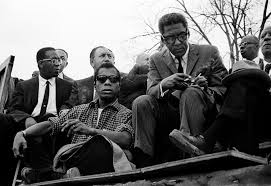
While putting the final touches on an essay about the Black Panther Party’s demise, Minister of Defense Huey P. Newton’s view of the group’s biggest mistake shocked me. According to Newton, the Black Panther Party’s most grievous error is Eldridge Cleaver’s unwise decision to distance the Panther Party from the Black Church.
A profound study of Panther history will implicate Eldridge Cleaver, the Panther Party’s Minister of Information, in what Newton considered an unjustifiable pattern of attacking Black Pastors in their place of worship. Making matters worse in Huey P. Newton’s mind was that Cleaver did such things in front of a startled and frightened congregation. Contrary to Eldridge Cleaver, Huey P. Newton believed that the Black Church was essential to the Black Panther Party because it was their only buffer against law enforcement agencies such as J. Edgar Hoover’s Federal Bureau of Investigation.
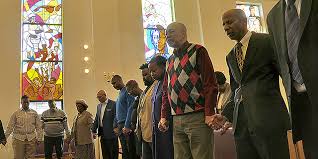
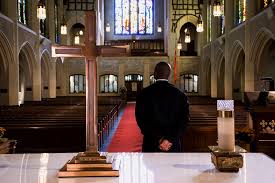
Huey P. Newton’s view of the utility of the Black Church to Black liberation struggles validates my long-held belief that our praise houses have been, are, and will always be the most important institution in Black America.
I am confident that many people will take issue with the above assertion. I ask those people to consider that the Black Church is the only institution capable of rallying millions of Black folks, votes, and dollars behind a single cause overnight. Within a Capitalist nation that rests on a system of representative democracy, there is strength in numbers. Despite wild assertions from naysayers, the Black Church is a powerful entity if guided by enlightened leadership. Without courageous visionary leadership, the power of the Black Church remains dormant.
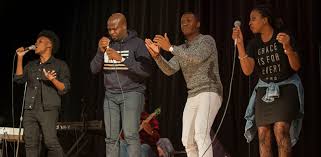
For those who do not believe that the praise house remains an important gathering spot for Black Millennials, recent data tells us that six in ten of them pray at least once a day; less than 40% of their non-Black counterparts pray at the same rate. According to a Pew Research Center Religious Landscape Study, Black Millennials also outpace their counterparts when it comes to attending religious services by a whopping 13%. The above study also reports that 64% of Black Millennials consider themselves highly religious — believe in God, consider religion important, pray regularly, and attend worship service.
When one considers the continuing importance of the Black Church to Black America, two things should be apparent.
- Black Pastors need to deliver sermons focused on the uplift of Black America.
- Black Millennials need to either leave or execute a hostile takeover of churches that refuse to focus their energies on the uplift of Black America.
It will be difficult to find Black Millennials raised hearing that old-time religion who disagree that the gospel must do much more than prepare our souls for the afterlife. I pray that Black Millennials will be able to do what those who came before them failed to do, that being, divorcing themselves from exhilarating emotionally charged messages devoid of substance.
If we learn nothing else from the history of the Black Panther Party, lessons regarding the essential nature of the Black Church to the advancement of our people are one of the most resounding. Now, suppose we could only get the Black men of God to realize that their leadership and sermons matter mightily to those who listen to them weekly. Were that achieved, Black Pastors would recognize the true power of the hermeneutical slices of the breath of God that they deliver to starving people every Sunday. I could make a strong argument that Sunday’s sermon is the single most significant factor in positioning our people’s minds for an exodus out of their earthly suffering.
Can I get an Amen?
James Thomas Jones III, Ph.D.
©Manhood, Race, and Culture, 2021